Records Commission Meeting: 9 AM on September 22nd, 2026 at 101 E. Main Street (BCC 3rd Floor)
To discuss the One-Time Disposal of Obsolete Records (RC-1) for the Public Health record series 9900-108, TB Case Records – X-Rays.
"We are informed that a mulatto woman, whom [Zeigler] kept in life, and by whom he had three [children], returned to this city yesterday morning, from near Cincinnati, and claims, in accordance with Zeigler’s will, … at least twenty thousand dollars apiece for the three [children]."
– Macon Telegraph, June 6, 1869
William Zeigler was an agricultural tycoon. Born in 1799 to a successful farmer in South Carolina, he and his siblings were raised in the thick of the farming and slavery industry. An ambitious young man, at the age of twenty-one Zeigler purchased 540 acres in Edgefield County, South Carolina.[i] That same year, 1820, he accepted from his father his sole inheritance: Sy and Phoebe, enslaved people presented as a Deed of Gift.[ii] Zeigler thus began his ascent, moving his enterprise to Georgia in 1827[iii] where he steadily cultivated his agricultural presence over the next 30 years.
At the height of his success, Zeigler owned over 8,000 acres in multiple counties throughout as many as nine plantations,[iv] and at least 200 slaves.[v] Zeigler’s staggering wealth was built, quite literally, from the ground up, and “furnished indubitable evidence that a farmer may become rich.”[vi]
Zeigler was referred to as an honest man of high character. He met the standards of responsible slave ownership at the time, maintaining his slaves as family units and never breaking them for the sake of a sale.[vii] When food and resources were scarce, he was said to ensure his provisions were sold locally to struggling families at a fair rate,[viii] prioritizing community over revenue.
Yet, as a proprietor of slavery his accolades are overshadowed. Zeigler’s empire was built upon the free labor of enslaved people. He, like much of the country, was plagued by selective morality.
Mary was born in Virginia. Though sources vary on her year of birth, it is estimated as either 1829 or 1830.[ix] Details of her childhood are unknown, but sometime before 1847 she was purchased by Zeigler and transferred to his plantation in Bibb County, Georgia.[x] There, in 1848, at the age of eighteen, Mary gave birth to her first child, Malinda Ann. About a year later her son, William Henry, was born and two years following, her daughter, Octavia.[xi]
Zeigler, never married and thirty years Mary’s senior, was the father of her three children.
"During his life he owned a woman slave named Mary, by whom he had three children…the paternity of whom, it is conceded, Mr. Zeigler always acknowledged."
– Weekly Constitutionalist, September 1, 1869
Mary’s opinion of her relationship with Zeigler is undocumented. Her freedoms, choices, and treatment are unknown. Zeigler’s great affection for Mary and their children, however, is evidenced both by his public acknowledgement of his paternity, and more relevantly, by his great effort to ensure their future freedom and security. As later noted in the Macon Telegraph, “The future welfare of this woman and her children seemed to be his chief care.”[xii]
Aware that Mary and the children would outlive him, Zeigler formed a legal strategy to protect them upon his death. Perhaps much sooner than he anticipated, this strategy was put to the test. Zeigler died in June of 1855, at the age of 56. The fates of Mary, Malinda Ann, William Henry, and Octavia were suddenly at the mercy of the court, and Zeigler’s final will and testament.

Figure 2 Notice of Executor's Sale of nine plantations owned by William Zeigler - Georgia Telegraph, 1855
John W. Dent, Zeigler’s nephew and executor of his will, acted quickly upon his death. Extensive inventories were conducted, appraisals determined, public sales planned, and by early September, notices were posted in newspapers throughout Georgia, inviting the public to buy up nearly everything Zeigler owned, including his enslaved people. Mary and her children were listed on one such inventory with a valuation of $1,800.[xiii]

Figure 3 Valuation placed on Mary and her children before their manumission. Inventory
and Estate records of William Ziegler, 1855
For the people enslaved on
Zeigler’s plantations, this was a tumultuous time. Everything, and everyone,
was for sale. If Mary was aware that she
and her children were intended protection through Zeigler’s will, her optimism
was likely tethered knowing her future rested with the men responsible for the
will’s execution.

Figure 4 Advertisement of the public sale of 200 enslaved people from Zeigler's estate –
Federal Union, 1855
An Act of the General Assembly of Georgia in 1815 prohibited manumission, the emancipation of slaves, through wills. A slave could not be freed “by will, deed, contract” or “agreement.”[xiv] Any language in such a document that attempted to directly manumit slaves was simply omitted from the official court recording. Zeigler was undoubtedly advised to use care with the wording of his desires for Mary and the children. To fail meant his family could be separated and sold at auction.
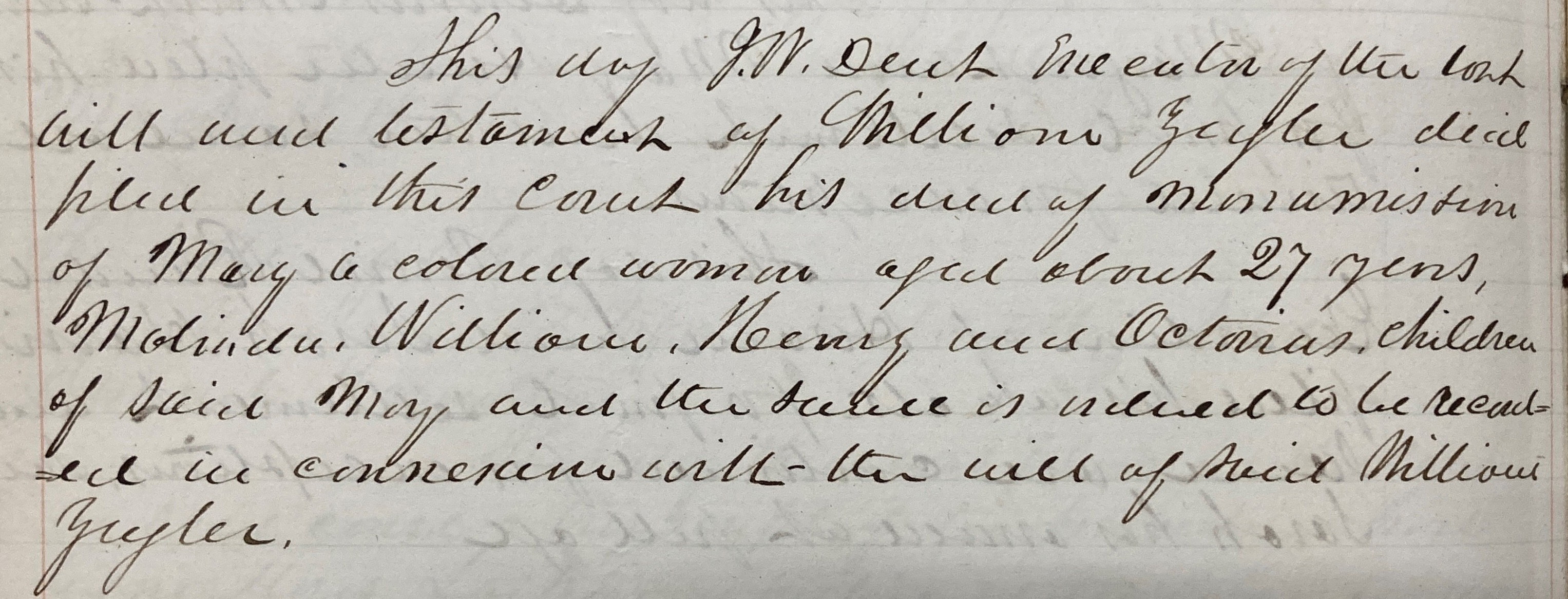
On July 2, 1855, Zeigler’s will was admitted to the Crawford County Court of Ordinary.[xv]
[It] is my desire, and so I direct, that the colored children of my Woman Slave Mary, be taken to a state where the laws thereof will tolerate their Manumission, or freedom…and […] that my Woman slave Mary the Mother of […] Malinda Ann, William Henry and Octavia be carried to a state where she may be manumitted and set free so soon after my death as it can conveniently be done.
Forgoing an attempt to free his family directly, Zeigler specified they be taken to a free state where they could then be legally emancipated. This language was ultimately successful, perhaps aided by the influence of Zeigler’s prominence and wealth. As for the family’s future prospects as free people, Zeigler intended to lay a foundation for their success.
[It is my desire that] they be […] put under Competent and proper Teachers […], where they may be properly educated... That they be provided with good and suitable board and lodging having an eye in this as with selection of teachers, to strict morality, also that they be properly clothed.
And in respect to the said William Henry, […] he shall receive a good Collegiate Education fitting him for any Profession he may choose...
Next, Zeigler established the parties responsible for his wishes regarding his children.
… I hereby nominate […] my beloved brother Henry Zeigler Guardian of […] Malinda Ann and my nephew John W. Dent guardian of […] William Henry and my brother Lewis Zeigler guardian of […] Octavius.
Zeigler placed all his trust in his two brothers, Henry Zeigler of Alabama and Lewis Zeigler of Louisiana, and his nephew, Dent. Zeigler not only had confidence they would carry out his wishes, he also trusted them with the long-term financial security of Mary and the children. This was of supreme importance, because William intended to bestow upon his family an astounding amount of money.
I direct that if […] Malinda Ann attaining to the age of twenty one, the sum of Thirty Thousand Dollars be paid to her […], and the further sum of thirty thousand dollars to be paid to William Henry if he attains to the age of twenty one years... And the sum of Thirty thousand Dollars to be paid to the said Octavius if she should attain to the age of twenty one. […] and the interest annually [paid] to each of them during Minority.
…and […] the sum of ten thousand dollars to my [brother Henry Zeigler] in Trust for [Mary’s] use, […] the said sum of ten thousand dollars shall be kept at interest...
In total, Zeigler left
$100,000 to his family, the buying power of over three million dollars today.
Bequeathing any amount of money to a slave was rare. This act would have been
beyond belief. Zeigler was himself concerned with its legality, adding a
codicil to his will five months prior to his death, “lest there […] be some
difficulty […] in consequence of my giving directly to [the children]”[xvi].
The addendum stipulated the $30,000 inheritance per child be given to their
guardians, on the child’s behalf, in a trust. This slight modification would
become significant.
Henry, Lewis, and Dent were now burdened with Zeigler’s family until the children turned twenty-one, perhaps an unpleasant surprise. The guardians were not to be left uncompensated, however, as they were also substantial beneficiaries, each to receive a share of the balance after the estate’s settlement. Perhaps Zeigler assumed this financial inheritance, coupled with familial loyalty, was enough to entice his brothers and nephew to commit to the guardianships.
Based on what would later
transpire, it is likely the three men had no intention of being tied to Mary
and the children for long.
In early 1856, Dent travelled with Mary and her children, then aged eight, seven, and five, from near Macon, Georgia, to Batavia, Ohio, a town about 25 miles east of Cincinnati and not far from the Ohio River, which served as a division between free and slave states. The journey would have covered over 1,000 miles as the route snaked through multiple pro-slavery states following available rail lines. Although the danger of such a trip was high - Mary and her children were not yet free -[xvii] they arrived in Ohio without documented incident.

Figure 5 Map of the United States in 1856, with a marked travel path by way of
illustration of a route Mary’s family may have taken using rail lines.
Dent filed Zeigler’s will with the Probate Court in Clermont County, Ohio. On March 20th, 1856, Mary, Malinda Ann, William Henry, and Octavia were granted “their liberty and entire freedom […] forever.”[xviii]

In January of 1857, Lewis Zeigler, guardian of Octavia, petitioned the Macon Circuit Court in Georgia to relieve him of the responsibility. He reasoned that since Octavia now resided in Ohio, “it will be inconvenient and troublesome […] to act as trustee.”[xx] Greene P. Culverhouse, attorney for Zeigler’s estate, consented to replace Lewis and act as trustee for Octavia, managing her $30,000 trust.
That same year, John W. Dent removed himself as guardian for William Henry. Again, Culverhouse assumed the role.[xxi]
Henry Zeigler would be next to renounce both his guardianship of Malinda Ann and his responsibility for Mary’s trust. He was replaced by Henry Crutchfield and Ewell Webb, respectively, also attorneys from Georgia.
Mary’s new life began with promise. She and her children settled into the small town of Batavia, a community with a relatively strong abolitionist sentiment. The 1860 census documented 45 Black residents in the area, with several owning property. Mary became one such owner in 1859.
It cannot be said that Mary chose a modest home on the edge of town. Quite the opposite, she purchased a stately brick house on a double lot for $1,000.[xxii] Located in the center of town near the courthouse, the area was often referred to as “Judge’s Corner” since a number of judges lived nearby. In fact, whether or not Mary knew it at the time, she had surrounded herself with several prominent citizens.
Judge Shepard F. Norris, from whom Mary bought the home, was representative to Ohio’s General Assembly, member of the Ohio Constitutional Convention - which formed Ohio’s new constitution in 1851 - and the first judge elected to the Common Pleas Court under said constitution[xxiii]. Norris, whose politics were once aligned with the “slave-democrats,”[xxiv] did an about-face while serving in the General Assembly and voted to repeal the “Black Laws.” Whether Norris’s policy pivot was motivated by a change of heart or political strategy is unknown, but he did resist the federal Fugitive Slave Act of 1850. Norris’ 1854 decision confirmed “that a slave brought into Ohio by or with the consent of the owner, […] is free.”[xx]
Across the street, the First Batavia Presbyterian Church was a hotspot of anti-slavery activity.[xxvi] Described as actively abolitionist, the church was pastored for a time by George Beecher, Harriet Beecher Stowe’s brother. Brice R. Blair, a founding member of the church, served as president of the Clermont County Anti-Slavery Society.[xxvi]
Next-door lived Judge Owen T. Fishback, also a member of the First Batavia Presbyterian Church and a prominent lawyer who throughout his career served as prosecuting attorney, judge, and state senator.[xxvii]
Among this illustrious company, Mary’s financial status is noteworthy. In 1860, Judge Fishback’s real estate and personal property were valued at $13,000, Judge Norris’ at $27,000, and Mary’s at $101,500.[xxix]

Figure 7 Home of Mary Zeigler, as it stands today.
After settling in her new
home, Mary decided she needed more room.
Besides herself and her three children, Mary had a servant living with
her, a young Black woman name Sarah Stratten, and Sarah’s 2-year-old daughter,
Ida May.[xxx]
Additionally, it seems Mary was pregnant at this time, as later census records
would indicate a child, Mary B., was born around 1861.[xxxi]
To create space for her expanding family, in August of 1860 Mary hired Jesse S. Dustin, also the proprietor of a general store, to build an addition to her house. The project was completed by the end of 1860 for $800.[xxxii]
While not much is known about Mary’s life during her first few years in Batavia, some inferences can be made based on her purchases. A good deal of fabric and sewing notions were purchased on behalf of her children, as well as gloves, belts, boots, and shoes, so they were likely well-dressed. Many school items were acquired, such as readers of multiple levels, spelling and arithmetic books, and pens, pencils, and paper.[xxxiii] The children were being educated, likely by a tutor at home. When sick, Mary took the children to one of several physicians in Batavia.[xxxiv] By all evidence, the family lived a routine, small-town life. Unfortunately, Mary’s hard-earned good fortune would soon begin to falter.

Figure 8 Receipt of Mary's purchases, 1858
In March of 1862, Jesse S. Dustin, the aforementioned proprietor of the general store, filed a suit against Mary in the Clermont County Court of Common Pleas,[xxxv] claiming in part, that she had not paid for almost three years’ worth of goods and services. A list of every single unsettled item, 880 in total, was presented in court. The balance reached $534.31. Dustin also claimed Mary had never paid for the addition to her home and asked for judgment in the sum of $1,334.31.
Mary would need an attorney. As she had no direct access to her money, which was controlled by Ewell Webb, in seeming desperation she sold the back lot of her property for $55 to a young woman who lived nearby.[xxxvi]
In the lawsuit, Mary’s attorney argued that she inherited $10,000, and each child $30,000, and that those amounts were “bequeathed in trust to trustees”.[xxxvii] The trustees, Webb, Culverhouse and Crutchfield, were said to have “select[ed] the persons and authorize[d] them to supply [Mary] with such articles as she might require […] and that [the trustees] settled with said persons and paid them therefor.” It was further stated that Dustin agreed to this arrangement and should look “alone to them for [payment].”
As to the claims regarding her home addition, Mary’s side appealed that the construction agreement was between Dustin and trustees Webb and Crutchfield, not herself, and Dustin “agreed to take […] Crutchfield and Webb for the payment therefor."
Dustin countered that he “knows nothing about the duty of the trustees […] and [he] denies that he made any agreement with the trustees.” The 880 items, he contested, were “for her own use, at her own request and upon her own responsibility.” He claimed he had separate accounts against the guardians of the children for unpaid goods so furnished to them.
The case dragged on for
months. By November of 1862, Dustin withdrew his claim regarding Mary's house but
held firm to his claim that the unpaid goods supplied to Mary were her
responsibility. The court agreed and ordered Mary to pay $590.
Unable to pay the debt, Mary attempted to sue Ewell Webb in 1862 to reclaim her full inheritance.[xxxviii] Greene Culverhouse, Octavia and William Henry’s guardian, agreed to spend a substantial $2,000 from their trust to hire attorney E. A. Nisbet, a former Georgia Supreme Court Justice, to manage Mary’s case.[xxxix] Resolution of this case could not be found, though there is implication that an appeal was anticipated with the Supreme Court of the Confederate States of America, a court that was never formally established.[xl] Later lawsuits suggest Mary did not receive any settlement from Webb at the time.
The debt to Dustin unresolved, Mary’s credit at his store dried up. She began shopping at Kline’s grocery store in Batavia, where she would eventually fall behind again.[xli] Interestingly, Dustin did not bring further suit against Mary.
The next several years saw
such a steady decline in Mary’s finances that by 1870 her personal value had
diminished to $100.[xlii]
William Henry was working as a stable hand[xliii]
and the girls may have worked as seamstresses,[xliv]
enabling the family to scrape by. Mary was ultimately pursued by
multiple creditors[xlv]
with no means to appease them. With Malinda Ann reaching the age of twenty-one
in 1869 and due her full inheritance, Mary and her children made the journey to
Georgia to officially challenge the trustees in court.
"We understand […] that Mr. Crutchfield is the guardian, or trustee, for the oldest daughter of Mr. Zeigler, and that he has within immediate reach, $20,000 for her, if it shall be decided that she is entitled to it."
- The Weekly Sun, Columbus, Georgia, June 15, 1869
For over ten years, Henry Crutchfield, Greene Culverhouse, and Ewell Webb had combined control of well over $100,000 belonging to Mary’s family, spending very little on their behalf. Living states away, they were physically removed from the family and any oversight.
Mary obtained the council of attorneys Col. John B. Weems and Col. Lewis Neal Whittle, both highly prominent and respected men in Georgia, and veterans of the Confederate Army. The firm of Nisbet and Jackson was also associated with the case, E.A. Nisbet having handled Mary’s 1862 case against Webb.
Lawsuits were ultimately filed on behalf of each child in the Crawford County Superior Court. Since William Henry and Octavia were not yet 21, Mary filed as their representative. The attorneys claimed nearly $200,000 was due to the family.[xlvi] The case received much public attention and gossip, with articles detailing the case published in newspapers across Georgia. The court appointed new guardians for the children during this time, although Ewell Webb remained Mary’s trustee.
In the case of Octavia Zeigler vs. Greene Culverhouse, it was firmly argued that Culverhouse “received the […] sum of thirty thousand dollars bequeathed to [Octavia] and wholly failed to discharge his duties as Trustee […] that he hath not paid […] to her […] any part thereof for many years […] but hath managed the same for his own benefit […] and will give [Octavia, Mary, and their attorney] no account of what he has done with the principal sum.”[xlvii]
After filing the initial lawsuits, the family returned to Ohio. The cases would be trapped in the judicial process for several years. Georgia, like the rest of the South, was recovering from the Union victory, resulting in a bogged down legal system.
In 1872, Mary, now 43 years
old, along with Malinda Ann, 24, William Henry, 22, Octavia, 20, and Mary B., 11, left
Ohio and returned to Georgia for good. At least six local lawsuits were pending
against Mary at the time for debts,[xlviii]
including a suit from the heirs of Jesse
S. Dustin, deceased, for the $590 judgment. Mary’s beloved home was eventually
sold by Sheriff’s sale in 1873 to Judge Philip B. Swing,[xlix]
one of the witnesses who signed Mary’s freedom papers.
In March of 1875, Mary
received a jury verdict in her case against Ewell Webb.
"We the jury […] find and decree in favor of said Mary Zeigler and her three children… That Ewell Webb as Trustee has […] the sum of ten thousand dollars principal with [interest increasing the total to] twenty six thousand eight hundred and ninety three and forty nine cents. We further find that [the stated total] belongs to and is the right and property of said Mary Zeigler."
- Crawford County Superior Court records, March 1875
The jury further ordered that Ewell Webb be removed as trustee and replaced with Mary’s attorney James J. Nisbet, of Nisbet and Jackson.
It was revealed during the
case that Webb produced only one documented return as trustee for Mary, dated
1857, “the only return he has made as such guardian.”[l] The
return shows Mary received $20, possibly the only money Webb ever provided her.

Figure 9 Copy of Ewell Webb's only financial return as Mary's guardian. Crawford County Superior Court record, March 1875
Mary signed the Superior
Court journal when the case was finalized. With no existing photos of Mary or
even direct quotations, her signature preserved is quite exceptional.

Figure 10 Signature of Mary Zeigler, 1875
Although it would be pleasing to believe Mary finally collected her inheritance, the unfortunate fact is she may have never received anything. In 1881, six years after the judgement, her attorney and trustee, Nisbet, sued the estate of the deceased Webb on behalf of Mary and her children, levying against the lands owned by the estate for the sum of $27,418.49.
The results of the cases against trustees Crutchfield and Culverhouse could not be located at the time of this writing, though there are certainly more records to be found. The family’s circumstances in the years following the lawsuits, as described below, may reveal the likelihood of their having received any portion of their inheritance.
Malinda Ann purchased a home valued at $1,500 on Spring Street in Macon, Georgia, around 1878,[li] and lived there with Octavia for at least ten years. They were unmarried and working as seamstresses.[lii] Octavia had also purchased an acre of property,[liii] suggesting both women may have received some portion of their inheritance.
The 1880 census reveals that a one-year-old female, Malinda, was living with the sisters on Spring Street. She is recorded as the niece of Malinda Ann. Since both women were unmarried, it is possible they each claimed the child as a niece, the young Malinda potentially being either’s daughter. After 1888, no records were located regarding Malinda Ann, Octavia, or young Malinda. It is possible they married, taking new last names.

Figure 11 Inset map of Macon, Georgia, indicating the home of Malinda and Octavia Zeigler, about 1880
William Henry owned a home in
Bibb County,[liv]
so he, too, may have received some part of a settlement. He married Jane Johnson[lv]
and in 1879 they had a son, William Jr.[lvi] William Henry worked as a farm laborer for a
time but transitioned to working for the Macon and Western Railroad. In 1892
their son Willis[lvii]
was born. By 1910, William Henry was 62
years old, still working for the railroad, and was recorded as fully literate. He died sometime before 1929.[lviii]

Mary also settled in Macon, like her children, and rented a home with her youngest daughter, Mary B., who worked as a cook for a private family.[lx] Mary was recorded in the 1900 census as a widow, perhaps referring to her relationship with William Zeigler, as no documentation of her ever marrying was located. By 1900 she was in her early 70’s, working as a washerwoman and living on Ash Street in Macon. Mary’s name could not be located after 1900, suggesting she may have died before the 1910 census.
In the Oak Ridge section of the Rose Hill cemetery in Macon, designated
for Black burials,[lxi] there
is a headstone of a Mary Zeigler who died in 1908, not far from the burial site
of William Zeigler.

I wish to give my utmost thanks to Louis Childers, without whom I may have never known Mary’s name, as her story rested quietly in the archives of Clermont County, Ohio. Louis’ knowledge of Mary and William Zeigler is tremendous, and his hands-on research in Georgia was invaluable to me.
[i] Deed
Book, Edgefield County, South Carolina, September 9, 1820.
[ii]
Deed of Gift records from Nicholas Zeigler to William Zeigler, Richland County,
South Carolina, 1820.
[iii] Obituary
of William Zeigler, Georgia Journal and Messenger, June 27, 1855.
[iv] Georgia
Telegraph, September 4, 1855.
[v] Milledgeville
Federal Union, May 13, 1856.
[vi] Obituary
of William Zeigler, Georgia Journal and Messenger, June 27, 1855.
[vii] Milledgeville
Federal Union, May 13, 1856.
[viii]
Obituary of William Zeigler, Georgia Journal and Messenger, June 27,
1855.
[ix] The
birth year of Mary Zeigler conflicts throughout several sources, including
census records and court records. It is possible she did not know her birth
year.
[x]
Inventory and Assessment records of the Estate of William Zeigler, 1855.
[xi]
Octavia was sometimes written as Octavius, depending on the source. She is,
however, routinely listed as female in census records.
[xii] Macon
Weekly Telegraph, August 10, 1868.
[xiii]
Inventory and Assessment records of the Estate of William Zeigler, 1855.
[xiv] Act
of 1815, Georgia State Archives.
[xv]
Final Will and Testament of William Zeigler, Crawford County, Georgia, July 28,
1854.
[xvi]
Codicil to the will of William Zeigler, Crawford County, Georgia, January 29,
1855.
[xvii]
The Fugitive Slave Act of 1850 made slave-catching a lucrative business.
[xviii]
Manumission Record of Mary Zeigler and Children, March 20, 1856, Clermont
County, Ohio Probate Court, Journal 2.
[xix]
Hereinafter Mary is legally referred to as Mary Zeigler.
[xx]
Macon Circuit Court Petition, Macon, Georgia, January 17, 1857.
[xxi]
Receipt records of J. S. Dustin, Clermont County, Ohio, 1858-1859.
[xxii]
Deed Book A4, Clermont County, Ohio, 1859.
[xxiii]
History of Clermont County, 1880.
[xxiv]
Daily Ohio State Journal, August 9, 1849
[xxv] New
York Daily Times, August 10, 1854.
[xxvi]
Rockey and Bancroft, History of Clermont County, Ohio, 267-269.
[xxvii]
Clermont Courier, “Clermont County Anti-Slavery Society”, January 13,
1838.
[xxviii]
Rockey and Bancroft, History of Clermont County, Ohio, 164, 260.
[xxix]
1860 Census.
[xxx]
1860 Census.
[xxxi]
1870 Census. It is likely that Mary B. is daughter of Mary Zeigler and not
Malinda Ann, who was about 13 when Mary B. was born.
[xxxii]
Common Pleas proceedings, Clermont County, Ohio, November 1862.
[xxxiii]
Receipt records of J. S. Dustin, Clermont County, Ohio, 1857-1859.
[xxxiv]
Receipt for medical services, 1858-1859.
[xxxv]
Common Pleas proceedings, Clermont County, Ohio, November 1862.
[xxxvi]
Clermont County Mortgage book 11, 1863. Mary sold the lot to a 24-year-old
female immigrant from Germany, perhaps a friend, with an agreement that if she
repaid it with interest within one year, she could regain ownership. Notes on
the side of the mortgage imply that Mary may have repaid it.
[xxxvii]
Common Pleas proceedings, Clermont County, Ohio, November 1862.
[xxxviii]
Superior Court records, Macon, Georgia, January 8, 1862.
[xxxix]
Notably, Nisbet had only one year prior been instrumental to Georgia’s
secession from the Union. Journal of the Public and Secret Proceedings of the
Convention of the People of Georgia, 1861.
[xl] Charles
E. George, “The Supreme Court of the Confederate States of America”, The
Virginia Law Register, December 1920.
[xli]
Appearance Docket, Clermont County, Ohio, Common Pleas Court, 1872.
[xlii]
1870 Census.
[xliii] William Henry worked as a hostler according to the 1870 census.
[xliv]
Macon City Directory, 1880.
[xlv]
Appearance Dockets, Clermont County, Ohio, Common Pleas Court, 1872.
[xlvi]
Weekly Constitutionalist, September 9, 1869.
[xlvii]
Superior Court Minutes, Crawford County, Georgia, 1869.
[xlviii]
Appearance Docket, Clermont County, Ohio, Common Pleas Court 1872.
[xlix]
Common Pleas proceedings, Clermont County, Ohio, 1873.
[l]
Superior Court Minutes, Crawford County, Georgia, March 22, 1875.
[li]
Property Digest Records, Bibb County, Georgia, 1878-1883.
[lii]
Macon City Directory, 1888.
[liii]
Tax Records, Bibb County, Georgia, 1878-1880.
[liv]
Property Digest Records, Bibb County, Georgia, 1890.
[lv]
Marriage Certificate of William Henry Zeigler and Jane Johnson, Bibb County,
Georgia, December 21, 1877.
[lvi]
1900 Census.
[lvii]
1910 Census.
[lviii]
Death Certificate of Jane Zeigler, Georgia State Board of Health, January 9, 1929.
[lix]
Possible photograph of William Zeigler, Jr, undated, but estimated as the
1910’s. This is believed to be a photograph of William Henry Zeigler’s son.
Provided by Louis Childers, researcher.
[lx]
1900 Census.
[lxi]
Oak Ridge Cemetery historical marker, Georgia Historical Society.
[lxii]
Possible headstone and final resting place of Mary Zeigler in Oak Ridge
Cemetery in Macon, Georgia. The age at death as listed on the tombstone does
not coincide with her estimated year of birth, but as noted in Endnote 9, her
age and year of birth vary by source. Because Mary is believed to have passed
away before 1910, and Oak Ridge Cemetery is in Macon, where Mary lived, and it
is the designated section for Black burials, and because Oak Ridge is part of
the larger Rose Hill Cemetery, where William Zeigler is buried, it is possible
that this headstone belongs to the Mary Zeigler of this story.